
The movements of plants, diseases and culture between the ‘old’ and ‘new’ worlds has been also referred to, rather erroneously, as the Colombian Exchange, in deference to Spanish sailor Cristóbal Colón who is known, in English, as Christopher Columbus.
This ‘exchange’ speaks (however accurately or inaccurately) of the goods, as commodities, but also the diseases, knowledges, ideas and languages, humans and other animals that criss-crossed the Atlantic and which led to significant changes in culture, society and life beyond the domain of the human. It was a time in which the anthroposcene accelerated and which has, perhaps more accurately been referred to as the capitalocene or plantationocene. Kathryn Yusoff in her book: ‘A Billion Black Anthropocenes or None’ describes the ‘geosocial formations’ associated with human presence on earth both convincingly and in depth and allows one to understand just how incommensurable the ‘exchange’ was, foundational as the moment was to the loss, grief and deprivations, both human and more than in its wake.
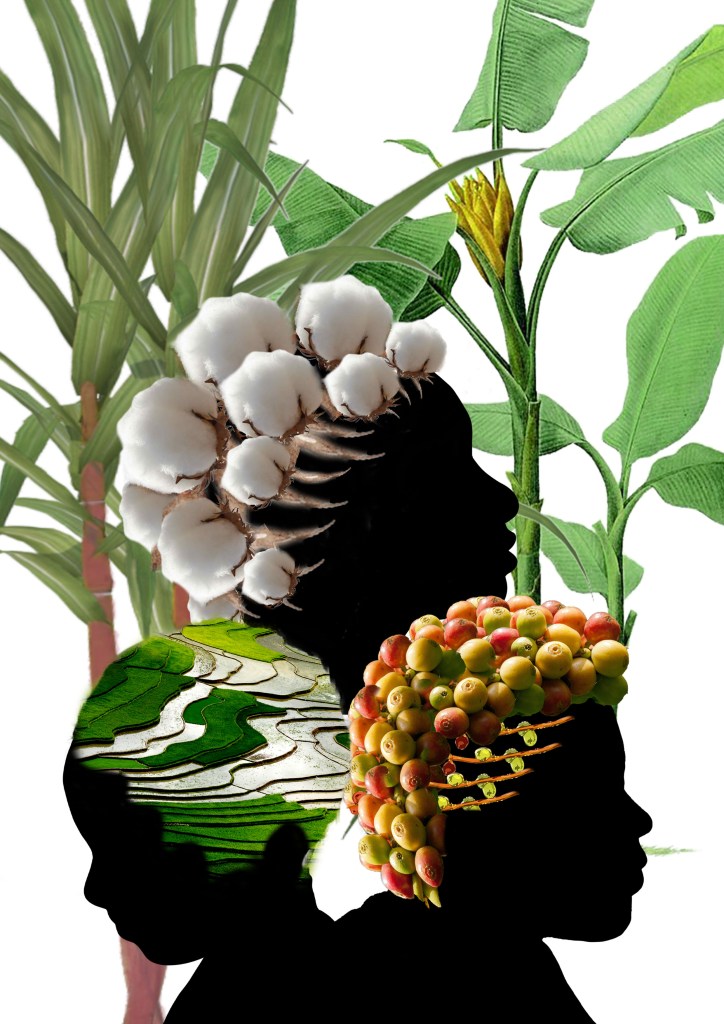
“Since the rise of the Colombian Exchange,10 the movements of germplasm reached a global dimension and a pace the world had never seen before. Ascending capitalism became a driving force in shaping this process (Kloppenburg, 1988:153). Europeans collected seeds and crops from the colonies extensively for selection, duplication and growing in other colonies with conducive environmental conditions.
The Royal Botanical Gardens at Kew in England was the most important centre in a network of more than sixteen hundred botanical gardens in Europe (Fowler, 1994:6), and in the colonies new botanical gardens were established. Plantations expanded rapidly in the colonies in the second half of the nineteenth century and introduced new crops in areas where the old where displaced. However, this also created conditions for new diversity to emerge (Fowler and Mooney, 1990:41). In the twentieth century these actions slowed down, concentration on selected crops intensified and plant explorers rather searched in the Vavilov centres of diversity for new genes and traits for breeding programmes in order to improve the varieties in use (Fowler and Mooney, 1990:41). In the wake of the new breeding technologies and monocultures, the excessive dispersal of germplasm turned into a dramatic erosion of genetic resources.”
 Community Centred Knowledge